
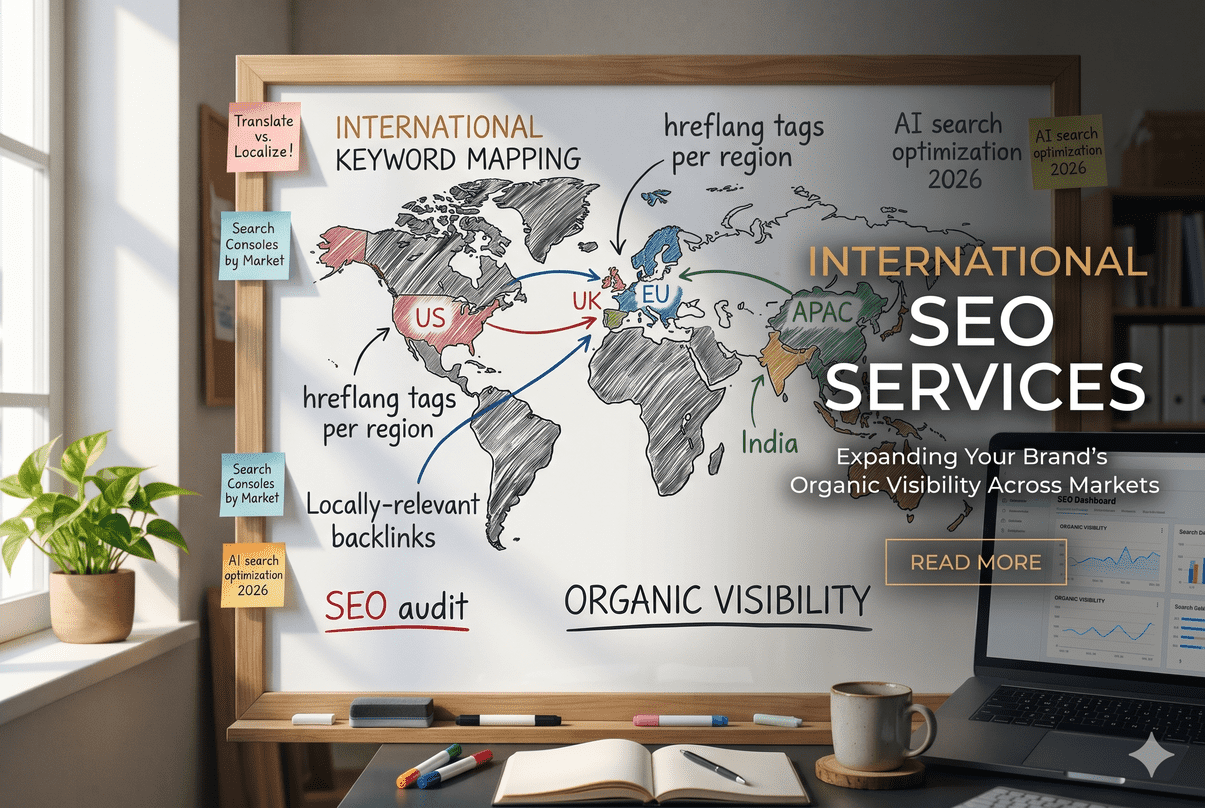


International SEO services, sometimes sold as global SEO services, help your site show up in search results in other countries and languages. Swap the language on your site and hope it ranks somewhere new? Plenty of companies try it, and it mostly doesn’t work. Germany or the UK doesn’t need a translated page. It needs a site that reflects how people there actually search.
What Is International SEO?
International SEO is the process of optimizing your website for each country and language you target, so search engines show it, and AI tools cite it for the right searches. It tells Google that your UK page is for British shoppers, your German page is for German speakers and your Indian page is for Indian buyers, so nobody lands on the wrong one.
It isn’t the same as local SEO, which helps you win searches in one city or area. It isn’t quite multilingual SEO either, which is mostly about language. International SEO covers both country and language, because people who share a language don’t always search the same way. Someone in Delhi and someone in London may both search in English, but they’ll use different words, compare different brands and expect different prices.
When Does Your Business Need It?
You probably need it when the signs are already there: traffic from countries you don’t serve yet, enquiries from abroad, or expansion plans. A site loads anywhere, but that doesn’t mean it’s optimized for anywhere. Get it right and you reach customers you’d have missed and lean less on paid ads.
How Do You Do Keyword Research for Each Market?
Research each market separately. A literal translation of an English keyword is often not what people type into Google. A British shopper says “mobile phone,” and an American says “cell phone.” Check what people actually say, whether they’re browsing or buying, and who owns the top results. This shapes your whole international SEO strategy.
How Should You Structure Your Site?
There are three main options:
- Country-code domains (.fr, .de): the strongest local trust signal, but the most expensive to run.
- Subdomains (fr.example.com): easier to set up, though they share less authority with the main site.
- Subfolders (example.com/fr/): the cheapest option, and they share authority with your main domain.
Pick the one that fits your budget and goals. Then keep it consistent, so users and Google always know which version belongs to whom.
What Is Hreflang and Why Does It Matter?
Hreflang tells Google how your regional pages relate, such as a UK English page and a US English page. It helps the right version show up for the right person. Use ISO 639-1 language codes and ISO 3166-1 region codes, and add an x-default for visitors who match no version.
Every page must link back to the pages that link to it. Keep canonical tags in line with your hreflang tags. Avoid redirecting visitors by IP address, because it can stop Google from seeing your other versions.
Translation vs Localization: Where Does a Multilingual SEO Agency Help?
Translation swaps words. Localization changes the rest: currency, units, cultural references, local rules and how people buy. A multilingual SEO agency brings language skill and search knowledge together. Good multilingual SEO services mean pages read naturally and don’t sound like they came out of a translation tool.
How Do Local Links and Digital PR Help?
Links and mentions from local publications and directories tell search engines your brand belongs in that market. Earning them takes a local angle, because a story that works in Mumbai won’t automatically work in Munich.
How Does International SEO Work for AI Search?
AI search tools pull answers from sources they trust, and those can vary by language and market. That’s what international AI SEO services focus on. Mentions in local-language publications help. So does keeping your brand details consistent across markets: name, descriptions and product names. Nothing guarantees a citation, but a clear, consistent brand gives AI engines less to get wrong.
What Changes for Enterprise Sites?
Thousands of pages across a dozen markets bring duplicate content, unclear ownership and messy reporting. Set clear rules for who owns each market’s content, automate the technical checks and report on each country separately.
How Do You Measure Results by Market?
Measure each market on its own. Use country-level Google Search Console data, rankings for each locale, conversions per market and your visibility in AI answers.
How Do You Choose an International SEO Agency?
Look for an international SEO agency that can answer four questions. Have they worked in your target markets? Is keyword research done per market, or faked with a translation tool? How do they handle the technical side? How do they report results by country? Expect months, not weeks, especially where local competitors have a head start.
If you’d like a second opinion on your current setup, book an international SEO audit with Blue Ocean.
Frequently Asked Questions
Is international SEO the same as multilingual SEO?
Multilingual SEO is mostly about language. International SEO adds country targeting, technical setup and local search behavior on top.
What affects the cost of international SEO services?
The number of markets, the number of languages, the size of your site and how much content you need. Ask any provider to explain what’s included.
How long before international SEO shows results?
Usually months, and sometimes longer in competitive markets where someone else already owns the top spots.
Does this only matter for big enterprise companies?
No. Any business entering a new country can benefit. The work just scales up for enterprise sites with huge page counts.